
Home / Four versions
Oopbuy storage after the free period: four versions side by side
Every Oopbuy page we read agrees on 90 free days. After that, the Storage page, the Customized logistics page, a value-added FAQ and an older helper article each describe a different ending. Here they are in full, with the day each one counts from.
This page: everything after day 90, as four Oopbuy pages describe it
Day 91 onward · all four
Four pages, four endings
On 10 October 2026 we read every Oopbuy help page that mentions storage. They agree on the first part: goods bought through the shopping agent service stay free for 90 days. They disagree on everything after that, and the disagreement is not small. One page sets no end date at all. One stops at day 120 and marks your items Abandoned. One allows up to six months but only if you ask while the item is between 60 and 90 days old. One says the whole six months are free.
We call them V1 to V4 in the order a buyer usually meets them, starting with the page linked from the footer of every Oopbuy screen. The chart below puts all four on one day scale so the four endings are visible at once. Nothing on this site ranks them; the last section explains why.
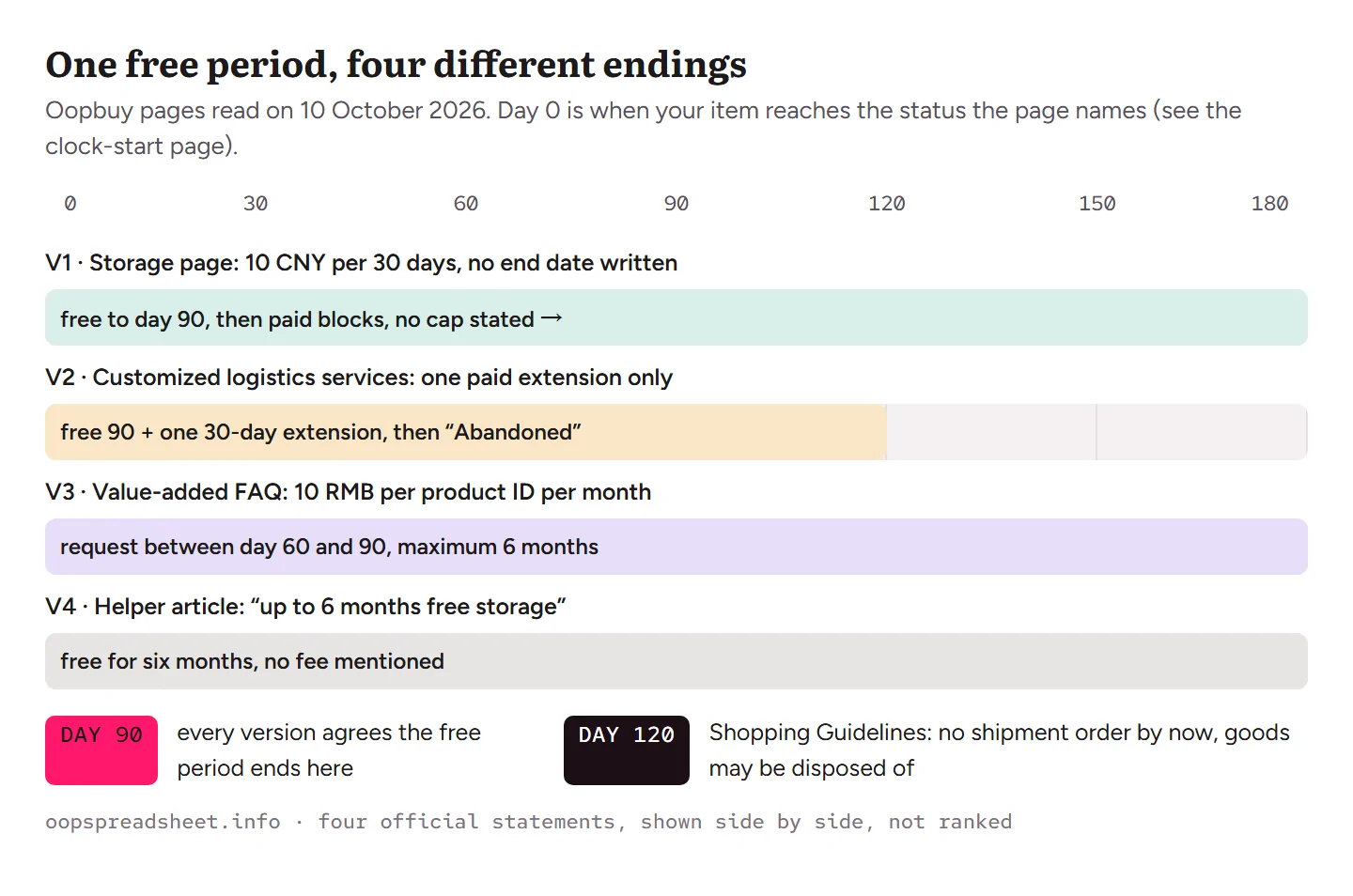
V1 · Storage page
V1: 10 CNY per 30 days, with no limit written
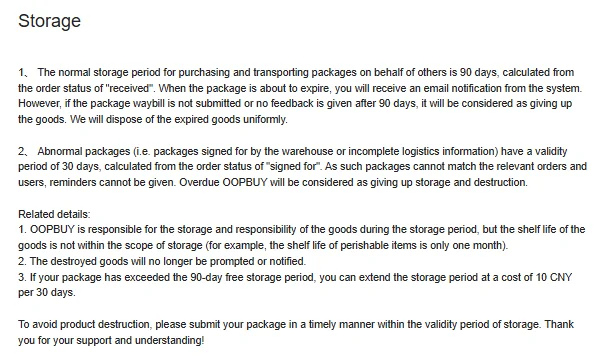
The Storage page sits in the footer under Warehouse & After-sale. Item 1 sets the free period: 90 days, “calculated from the order status of received”. Related detail 3 adds the extension: “If your package has exceeded the 90-day free storage period, you can extend the storage period at a cost of 10 CNY per 30 days.”
There is no cap. Read on its own, you could keep paying 10 CNY every month for a year. The catch is in item 1 of the same page, which says a package with no waybill or feedback after 90 days “will be considered as giving up the goods”. The day-90 page looks at how those two sentences can both be true.
V2 · Customized logistics services
V2: one extension, then Abandoned at day 120
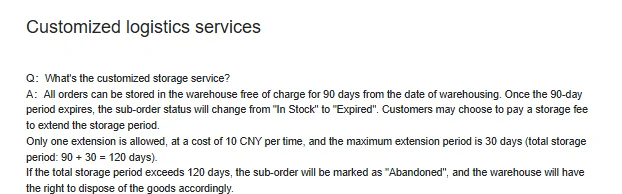
The Customized logistics services page is also in the footer, under Shopping Agent Guide. It counts the free 90 days “from the date of warehousing”. Once they run out, “the sub-order status will change from In Stock to Expired”.
Then the rule tightens: “Only one extension is allowed, at a cost of 10 CNY per time, and the maximum extension period is 30 days (total storage period: 90 + 30 = 120 days).” Past 120 days “the sub-order will be marked as Abandoned, and the warehouse will have the right to dispose of the goods accordingly.” Same price as V1, but one month only, and the unit is the sub-order rather than the package.
V3 · Value-added services FAQ
V3: 10 RMB per product ID per month, up to six months
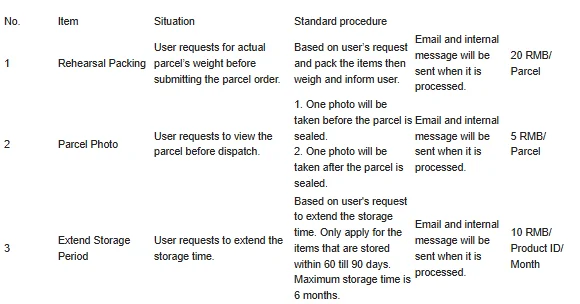
The FAQ titled Introduction to Warehouse Value Added Service Projects lists paid warehouse extras in a table. Item 3 is Extend Storage Period: “Based on user's request to extend the storage time. Only apply for the items that are stored within 60 till 90 days. Maximum storage time is 6 months.” The price given for it is 10 RMB / Product ID / Month.
Three things change here. The price is per product ID, so a parcel of six different items costs six times as much as under V1. There is a request window, day 60 to day 90, that closes exactly when V1 says the paid period opens. And there is a ceiling of six months, which is longer than V2 by about two months.
V4 · Helper article
V4: “up to 6 months free storage”
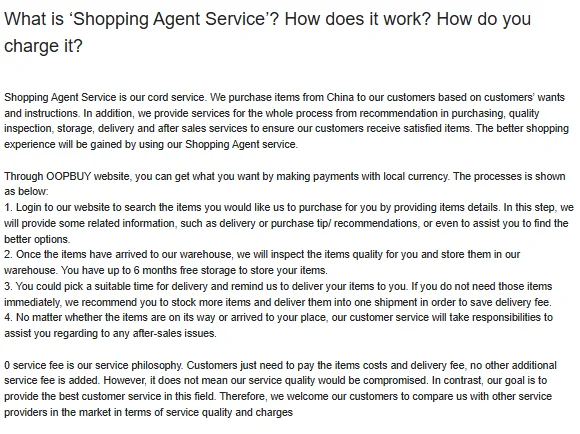
The helper article What is 'Shopping Agent Service'? How does it work? How do you charge it? walks through the service in four steps. Step 2 reads: “Once the items have arrived to our warehouse, we will inspect the items quality for you and store them in our warehouse. You have up to 6 months free storage to store your items.”
No fee, no request window, no day 120. It is the friendliest of the four and the one most at odds with the rest: the homepage strip, the first-order article and the Storage page all say 90 free days. The article still loads from Oopbuy's help list, so it is a published statement, and we show it. The six-month page looks at what it most likely is.
All four · units
The same parcel gets three different bills
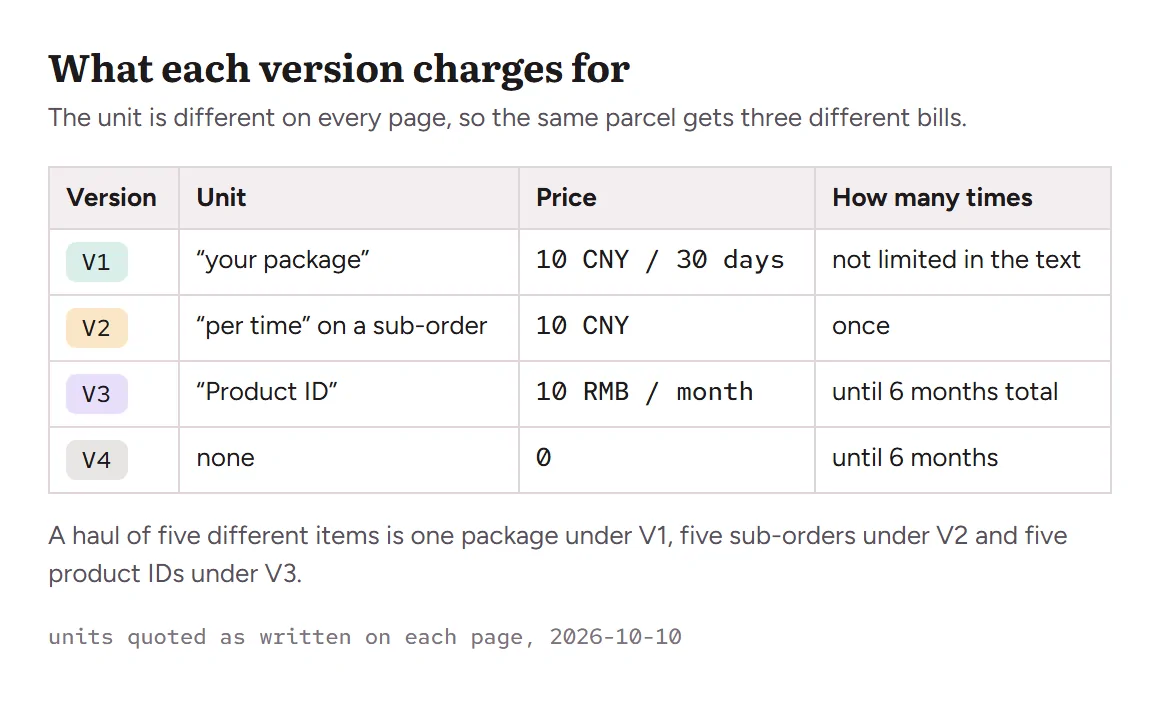
Even where two versions quote the same number, they apply it to different things. V1 prices “your package”. V2 prices an extension “per time” on a sub-order. V3 prices each product ID by the month. Put five different items in one parcel and the three pages describe one charge, possibly five charges, and five monthly charges.
That matters more than the headline price. A buyer who reads V1 and expects to pay 10 CNY for an extra month on a big haul may find the warehouse working from V3. The fee pages work the numbers through for 1, 3, 6 and 10 items.
Editorial note
Why we do not choose one for you
Oopbuy ranks its sources when they conflict in some areas, for example the Service & Fees page governs the service fee. For storage, nothing on the site says which page wins. None of the four carries a revision date. Two are linked from the same footer. So any choice we made would be a guess presented as a fact.
What we can say with confidence is this: if you ship before day 90, none of the four versions ever applies to you. If you need more time, ask support which rule covers your sub-orders and keep the written answer. The planner builds a schedule that is intended to leave a buffer before the normal 90-day reference, and the six-month page has a message you can paste to support.