
Home / Costs
Oopbuy costs: fees, the exchange rate and shipping lines
What an Oopbuy order is made of, from the item price to the declaration fee, plus the two numbers that are easy to misread: the estimator's fixed exchange rate and the top-up fee, which Oopbuy prints two different ways. Storage fees appear only if you are late.
This page: what you pay, and when
Fees · the parts
Oopbuy's fee structure and service fee
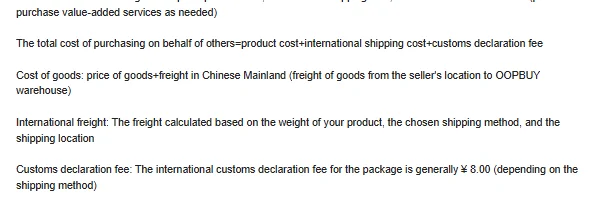
Oopbuy's Service & Fees page names three charges and nothing else: the product, international shipping and customs clearance, plus whichever value-added services you choose to buy. The total cost is product cost plus international shipping plus a customs declaration fee, which is “generally ¥8.00 (depending on the shipping method)”.
Product cost means the item price plus freight inside mainland China to the warehouse. No separate buying-service fee is listed there; funding, currency conversion and selected extras can still cost money. The optional extras, priced in the value-added table, are rehearsal packing, parcel photos and detailed photos, and the storage extension if you need it.
Fees · what you actually pay
What you actually pay, payment by payment
Payment 1 covers the item and domestic freight. Payment 2 covers international shipping and the declaration fee. In between, you may buy rehearsal packing (20 RMB per parcel) to learn the real weight before choosing a line, or detailed photos at 1 RMB each. Storage extension sits in its own box because it is the only charge you pay purely for being late.
Top-ups add a cost of their own. The Top up page charges PayPal at 4.5% + $0.30, while an FAQ still says “approximately (3.7% + 0.3 $)”. Both figures were present in the dated reading. Confirm the current funding screen instead of treating either historic rate as a guaranteed charge.
Rate · fixed divisor
The exchange rate built into Oopbuy's shipping quotes
Oopbuy's shipping estimator prints every route twice, in CNY and in USD. On 10 October 2026, a 1 kg US parcel of common goods on DDF-GOFO-US-1 showed 200.72 CNY and 33.59 USD. Divide one by the other and you get 5.9756, and every other route in the same response uses the same divisor.
That means the dollar figure is a fixed internal conversion, not that day's market exchange rate. If the market rate is higher than 5.9756 yuan per dollar, the USD figure is a little high; if it is lower, the opposite. This display comparison does not establish the cost of funding your account. Compare the amount debited, credited currency and the transaction fees actually shown.
Top-up · currencies
Currency conversion when you top up
The Top up page says Wise recharge supports five currencies (USD, GBP, EUR, NZD and AUD), and that PayPal recharge is converted to US dollars in real time whatever currency your account uses. It also mentions real-time adjustments based on the Bank of China exchange rate.
For planning, that means two conversions can sit between your bank and an Oopbuy price: your currency to USD at top-up, and USD to the CNY prices of items and services. Neither is a storage cost, but both are good reasons not to top up more than the parcel needs.
Shipping · lines
Shipping lines, delivery times and storage
The estimator returned 23 US routes for a 1 kg parcel on our reading date. The lowest-priced was DDF-GOFO-US-1 at 200.72 CNY, quoted at 15-20 workdays; the express ZD-UPS-US-HK quoted 7-12 workdays at 554.32 CNY. For Germany, SSF-DHL-DE-1 showed 8-14 days; for the UK, DDF-RoyalMail-GB-1 showed 7-14 days. Oopbuy's own Delivery Time page says “about 15-30 days depends on the destination”.
Transit time starts at dispatch and storage time ends there, so a slow line never eats into your 90 days. What can eat into them is indecision about which line to pick, which is what rehearsal packing is for.
Decision · wait or split
Waiting costs a fee, splitting costs a parcel
When one item is late, you have two ways to spend money. Keep the parcel waiting and you may owe a storage extension, priced one of three ways. Ship now and send the late item separately, and you pay a second declaration fee and a second first-weight step on most lines.
Neither is always cheaper. Put both versions of the parcel into the estimator on the same day, add the storage fee under the strictest reading, and compare. If the late item would take you past day 120, the comparison is already decided.
Build the budget in two passes
Before ordering, add the goods, domestic delivery and the actual funding cost. Make a shipping allowance using a plausible weight and carton size. After QC, replace the allowance with route quotes for the goods actually going into the parcel, then add selected packing, declaration, protection and destination charges where applicable.
For example, 300 CNY of goods plus 20 CNY of domestic freight is a 320 CNY goods subtotal. A hypothetical 180 CNY international charge brings that subtotal to 500 CNY before funding, extras and destination costs. These are example inputs, not an offer or an all-in quote.
A display-currency conversion, account credit and bank debit answer different questions. Compare all three before deciding a coupon saved money.
From a submitted parcel to a received order
- Before payment: confirm address, goods restrictions, packaging and the route-specific weight rules. A quote for one item does not approve every item in a combined parcel.
- After packing: compare actual dimensions and billed weight with the estimate, including adjustments and rounding.
- After dispatch: follow carrier scans. A label alone does not prove the carrier collected the parcel; a delivery range is an estimate, not a fixed arrival date.
- At receipt: inspect the carton and contents, preserve labels and packing, and record damage or shortages promptly for the relevant support channel.
Splitting a parcel can add another first-weight charge and other fees. Consolidating can increase volume or mix restricted goods. Compare both complete scenarios and their timing. See the official packing-to-delivery screens.